The Living Kingdom · 04 / 14
Brothers
The first fracture between people
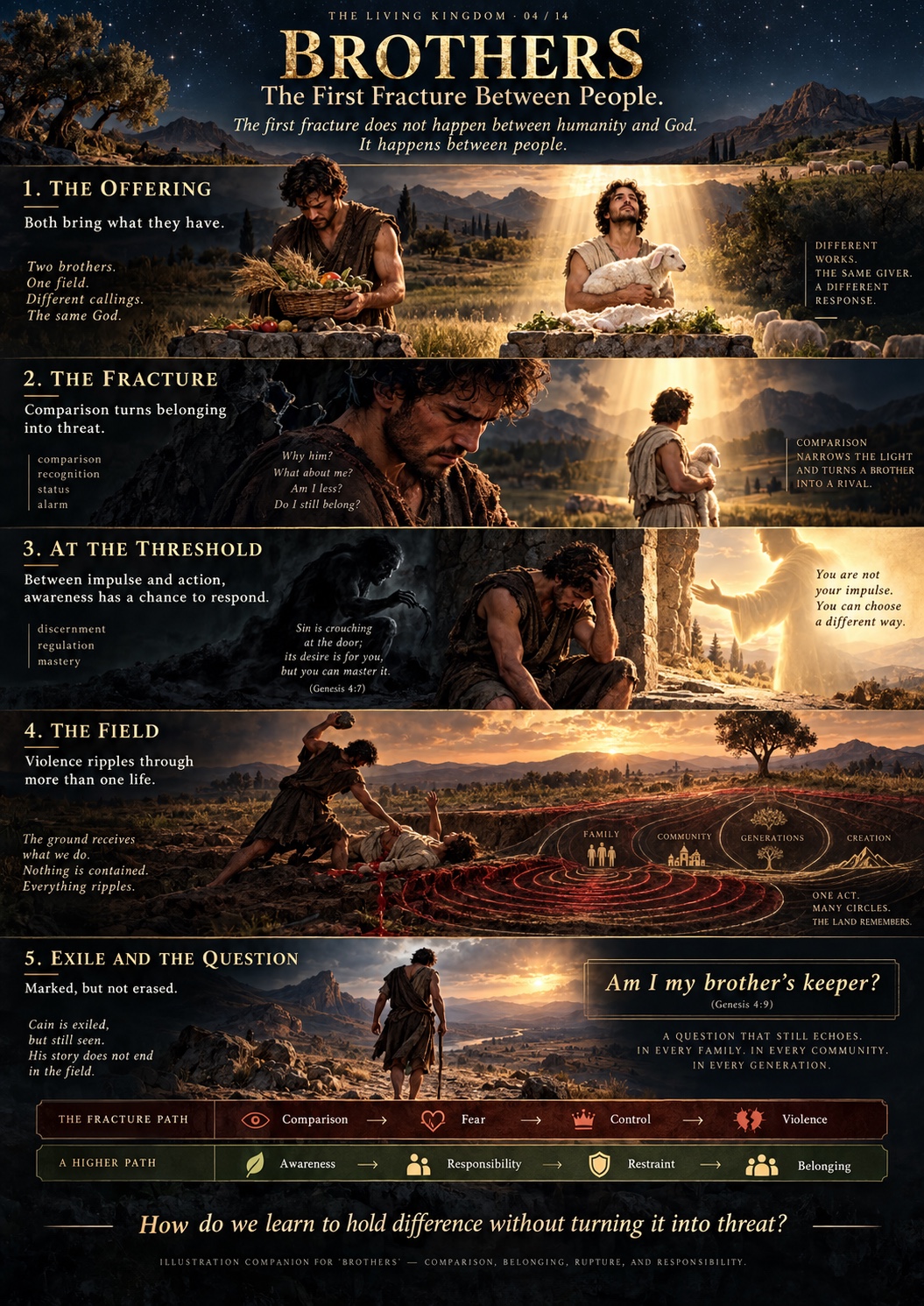
The first fracture does not happen between humanity and God.
It happens between people.
The first fracture does not happen between humanity and God.
It happens between people.
After the garden, the story narrows again. Not to nations or empires, but to a family. Two brothers. One field. One offering.
Cain and Abel.
The story is brief—almost unsettlingly so. No long explanations. No background. Just enough detail to feel the weight of what follows.
The Offering
Both brothers bring something forward.
Both offer what they have.
One tends the ground.
One tends living things.
The story never says one offering is evil.
It never says one brother is wicked.
It simply says one is seen, and the other is not.
The Fracture
And something shifts.
Cain notices.
This moment—not the violence—is the fracture.
Modern neuroscience helps us understand why.
The human brain evolved not only to survive nature, but to survive each other. Long before cities and laws, belonging meant safety. Exclusion meant danger. As a result, the brain is finely tuned to signals of status, fairness, and recognition.
When those signals feel threatened, the nervous system reacts before conscious thought has time to intervene.
Heart rate increases.
Stress hormones rise.
Attention narrows.
The body prepares for threat.
Cain’s experience is not abstract jealousy. It is a biological alarm triggered by comparison. His worth, once internal, becomes measured externally—through the perceived favor shown to another.
Evolutionary biology confirms this pattern.
In social species, comparison is unavoidable. Hierarchy emerges. Roles differentiate. When status feels unstable, aggression becomes more likely—not because of moral failure, but because the organism is attempting to restore equilibrium.
This does not excuse violence.
It explains its origin.
The story captures this with remarkable restraint.
Cain’s face falls.
His inner world darkens.
The Threshold
And then comes a moment often overlooked.
God speaks—not to condemn, but to intervene.
Sin is described not as identity, but as a force at the threshold—something that can be mastered or allowed entry. In modern terms, this is the space between impulse and action, where awareness has a chance to regulate response.
Psychology calls this emotional regulation.
Neuroscience calls it prefrontal inhibition.
Ancient wisdom calls it discernment.
Different languages.
Same human struggle.
But Cain does not speak.
Silence matters.
Trauma research shows that unexpressed emotion does not dissolve. It consolidates. When anger and shame are held without relational release, they seek external discharge.
The Field
Cain invites Abel into the field.
The violence is sudden.
The consequences are enduring.
This is the first recorded death in the biblical narrative, and it does not come from nature, disease, or accident. It comes from misdirected belonging.
The ground receives blood—the same ground from which humanity was formed. In ancient cosmologies, land was not inert. It was alive, responsive. Harm done to one part of the system echoed through the whole.
Modern systems theory says the same thing in different terms.
Violence destabilizes more than individuals.
It ripples through families, communities, and generations.
Trauma embeds itself not only in memory, but in physiology, behavior, and culture.
The Question
When Cain is asked where his brother is, he answers with a question that still defines moral tension:
Am I my brother’s keeper?
Anthropology suggests that the earliest human groups survived not because of individual strength, but because of mutual responsibility. Care for the injured, the young, and the weak is visible in fossil records long before organized religion.
In other words, keeping one another is older than doctrine.
The story does not respond to Cain’s question with philosophy. It responds with consequence.
Cain is exiled—not erased. Marked—not destroyed.
Even here, dignity is preserved.
This restraint is important.
The story refuses to simplify Cain into a monster. He is not expelled from humanity. He is carried forward as a warning, not a villain.
From this point on, the biblical narrative widens again—families, tribes, cities—but the pattern remains visible.
Comparison leads to fear.
Fear seeks control.
Control turns toward violence.
Astrologically and cosmologically, ancient cultures noticed the same pattern in the heavens: opposing forces, mirrored pairs, cycles of tension and resolution. Not as fate, but as pattern recognition—a way of naming recurrence across scales.
The Cain and Abel story is not about ancient brothers.
It is about what happens when awareness forgets connection and reduces belonging to scarcity.
And it leaves humanity with a question that science, story, and history all continue to ask:
How do we learn to hold difference
without turning it into threat?
That question does not get answered quickly.
But every story that follows is shaped by it.